Best Babbel alternative: real content after the course
You understand more than you can say. Spark is where you practice on real things after the lessons.
The verdict in 30 seconds
Babbel suits people who want a structured course, written by language experts, with a set path from day one.
Spark suits people who have done the lessons and want to learn from real articles, books and YouTube videos.
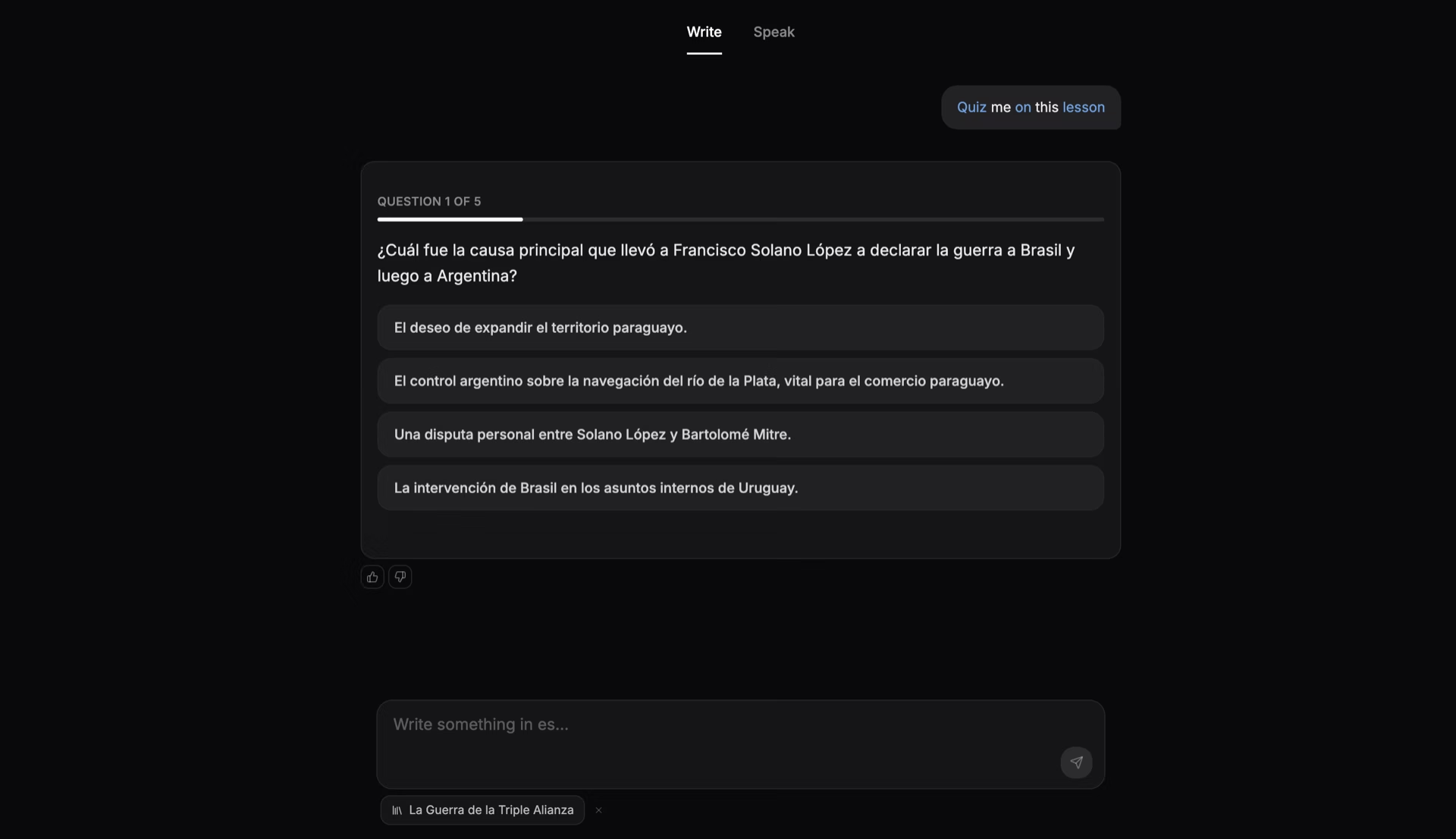
- Spark colors every word as you read and tracks the ones you meet.NewUnknownKnown
- After a piece, you chat about it. You type or speak; Spark replies in text for now.
- Babbel is stronger from zero, with offline apps and speech recognition in lessons.
Spark and Babbel, side by side
| Feature | Spark | Babbel |
|---|---|---|
| Choose your own content | Yes: YouTube videos, web pages, PDFs and EPUBs | No1. Lessons are Babbel's own, written by experts |
| Conversation practice | Yes: Chat about your piece; type or speak. Replies in text for now | Yes: Speech recognition in lessons. Babbel Speak AI, in beta2 |
| Word tracking | Yes: New, unknown or known as you read; known split passive or activeNewUnknownKnown | Partly: Spaced review of words from its own lessons |
| Levels | Partly: Short stories at your level, then real content | Yes: CEFR-aligned. Spanish to C1; Turkish only to A2 |
| Languages | Yes: 17 languages | Yes: 14 languages |
| Price | Yes: Free plan: Yes. Core $14.99/mo after a 7-day trial, no card | Partly: Free plan: No1; first lessons free. $17.95/mo3 |
 Spark
- 1Not found on Babbel's own pages, November 2026.
- 2Babbel Speak is a beta in Babbel's app, for Spanish, French, German and Italian. It is free to registered users for now; Babbel may charge for it or withdraw it.
- 3Babbel's 1-month plan is listed at $17.95, or $107.40 for 12 months (babbel.com, US, November 2026). One language is listed at $17.99 for 1 month or $89.99 for 1 year (US App Store, November 2026). Babbel says prices differ between web, iOS and Android.
How Spark works
Any YouTube video becomes a Spanish lesson
Who should pick which
Pick Spark if
- You did the lessons but still say little
- You want real articles, books and videos
- You want a chat about what you read
- You want review cards from your reading
Pick Babbel if
- You are starting a language from zero
- You want lessons built for your native language
- You want offline lessons on your phone
- You want pronunciation feedback in lessons
Review words from what you read
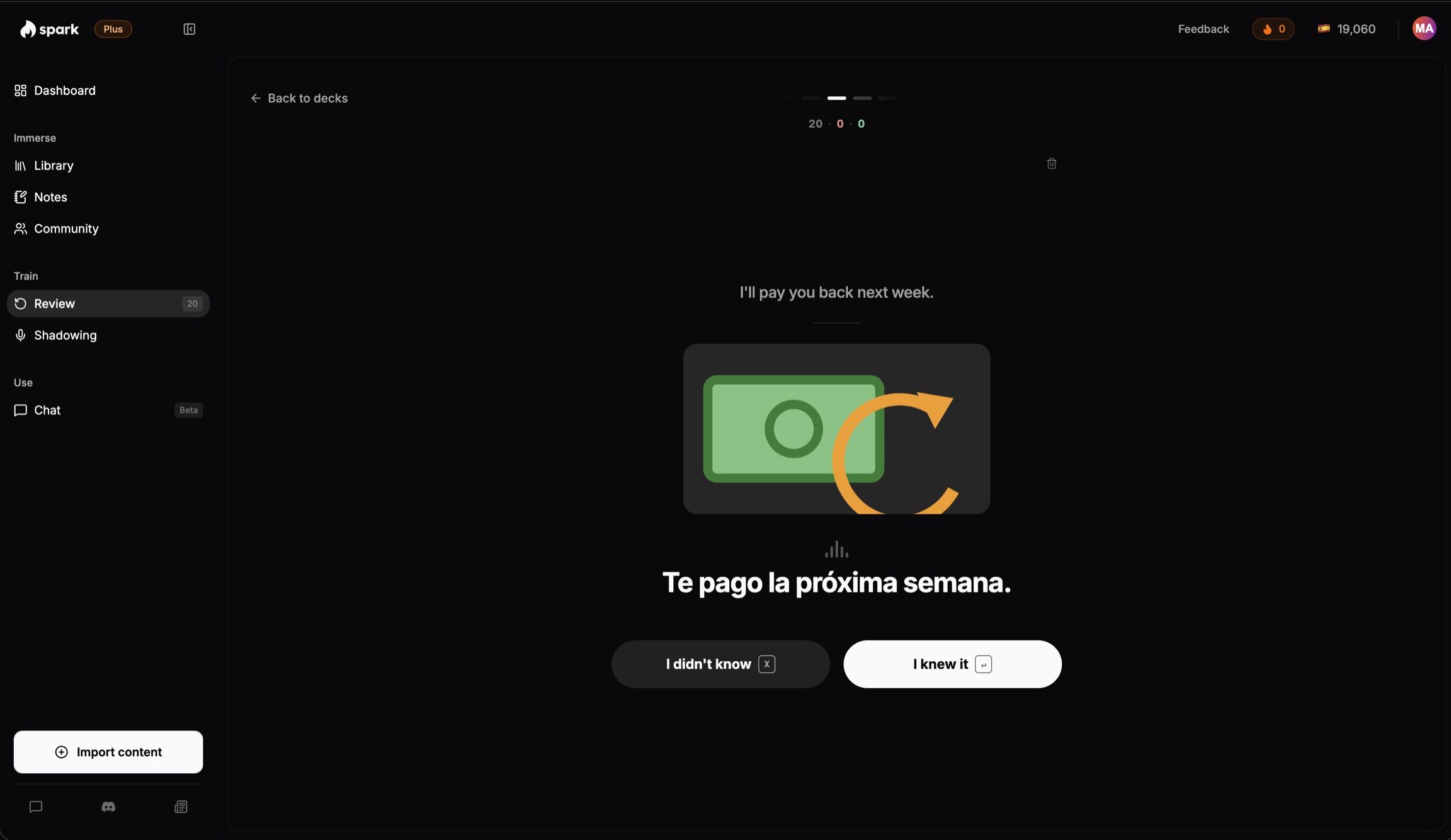
Babbel reviews words from its own lessons; Spark makes each card from the sentence where you met the word.
Where Babbel wins
- Expert-written lessons.Language experts write each course for speakers of your native language, and Babbel says its Spanish goes all the way to C1.
- Offline apps, Group plan.Its phone apps let you download lessons for offline use, and a Group plan covers up to 6 people.
- Speaking in lessons.Speech recognition gives feedback on your pronunciation, and Babbel Speak, a beta, adds guided AI conversations.
Questions people ask
- Babbel vs Spark: which should I pick?
- Pick Babbel to start a language with a structured course. Pick Spark once you have done lessons and want to learn from real articles, books and videos, then use their words in a chat.
- Is Babbel worth it?
- Yes, for a structured start: lessons written by experts, built for your native language, with free first lessons to try. What it does not do is let you learn from your own material; we found no way to import it.
- What should I do after Babbel?
- Start on real things you like, such as a news site or a YouTube channel. Look up only the words that block the meaning, review them, then retell the piece. Spark does all of this in one place.
- Is Babbel free?
- Not fully. The first lesson of every course is free, with no card needed until you subscribe. Babbel says that adds up to 80 free lessons, depending on the language.
- Babbel vs Duolingo: which is better?
- Neither wins outright. Duolingo's free plan, with ads, covers every course in 40+ languages. Babbel has no free plan and no ads, and teaches through set lessons. Spark is for the step after either. More in our Duolingo comparison.
See how much of a real article you know
Bring in a news story or a YouTube video and tap only the words you do not know.
Try Spark freeFree to start. No card needed.
More on Spark and Babbel
Where Spark is different from Babbel
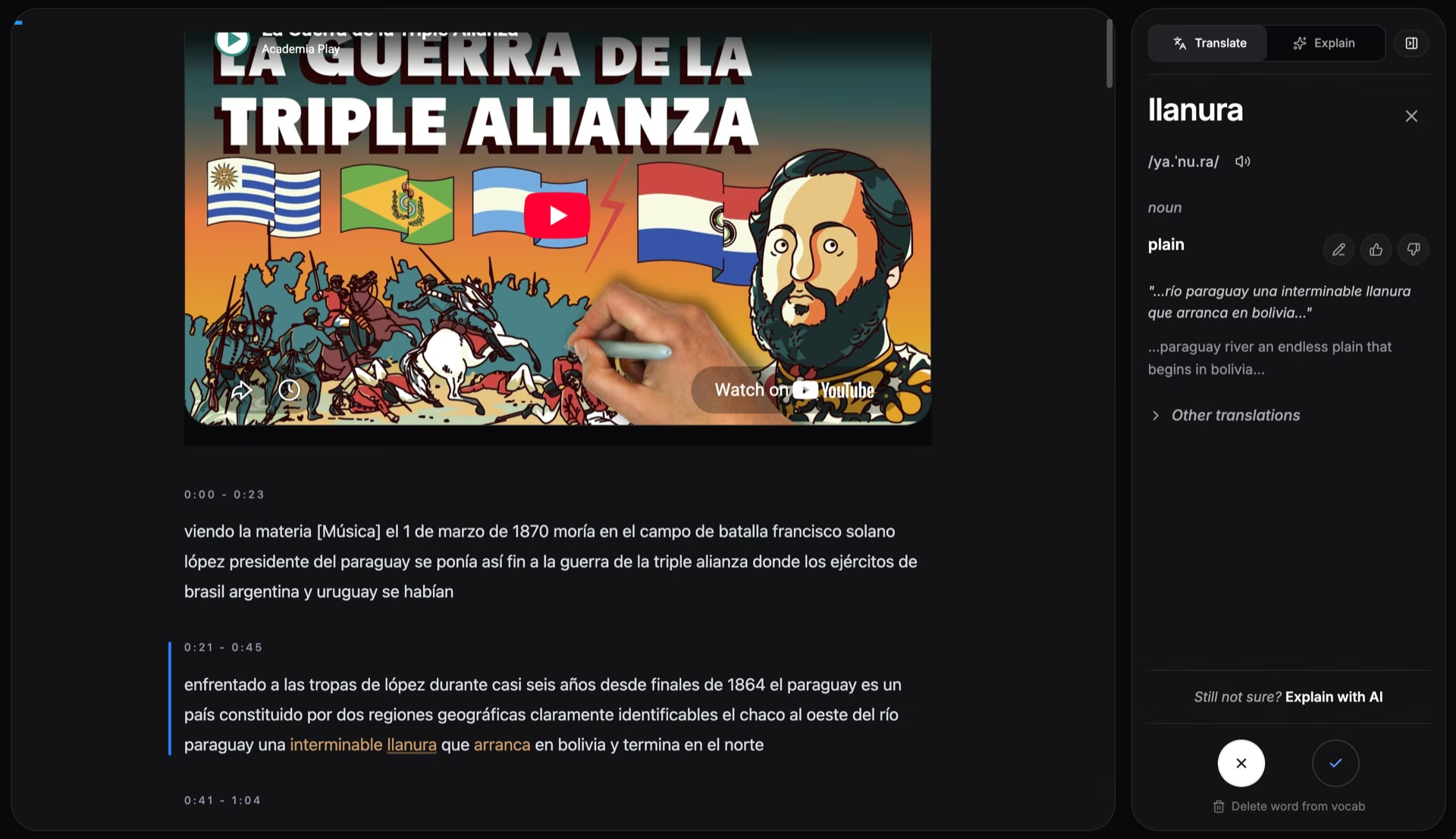
- Real content, not a course. Bring in a video from a YouTube channel you like, a news story, or a whole book as a PDF or EPUB, and read it with every word colored by how well you know it. Babbel's lessons and podcasts are made by Babbel, and we found no way to bring in your own.
- Review from your own reading. Babbel reviews the words from its own lessons with spaced repetition. In Spark, every word you look up becomes a review card built from the sentence you met it in, brought back at 1, 3, 7, 14, 30 and 90 days.
- Active, not only known. Spark splits known words into passive (you recognize them) and active (you can use them), and a word only turns active when you type it correctly without help, use it on your own in a chat, or still know it 7 days later.
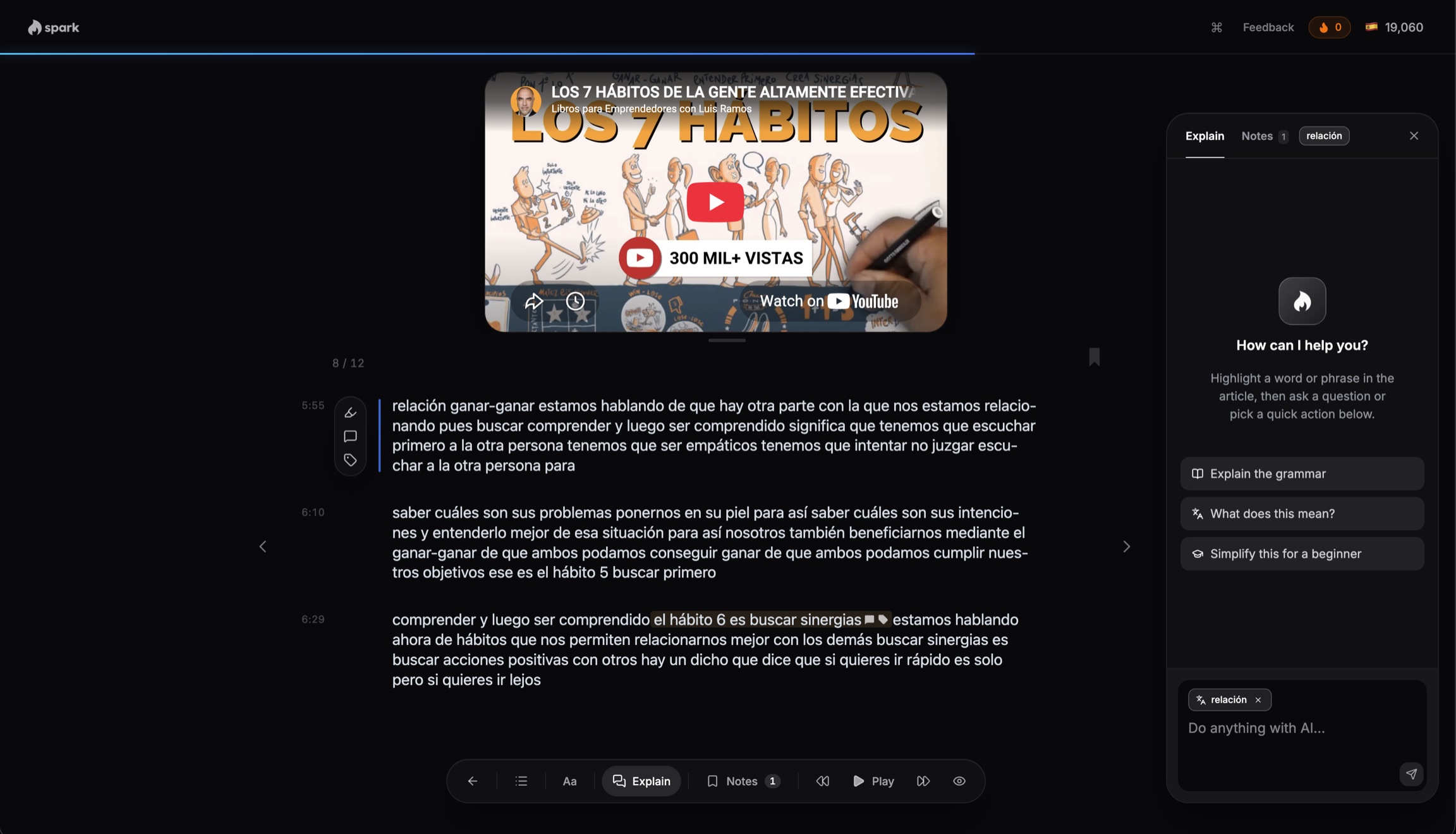
- A chat about what you read. After a piece, you chat about it in the language you are learning, and Spark corrects every message, with a more natural way to say it. You type or speak; Spark answers in text for now. Babbel Speak's AI conversations follow guided scenarios that Babbel sets.
- No course to follow. Spark has no course that tells you what to learn next. It works best once you can read simple real content; if you are starting out, it begins with short stories written at your level.
Switching from Babbel
- You start from zero. Nothing imports from Babbel, and Spark has no course to place you in; its only vocabulary import is from LingQ.
- Pick the language you are learning and answer a few short questions, including the topics you like and your level. Your dashboard then suggests up to three short articles, or you can bring in your own with the Chrome extension.
- What Babbel taught you still counts. Tap only the words you do not know; the rest count as known when you move on.
- Learning Spanish, French, German or Italian? Babbel's free podcasts, pitched at set levels and with transcripts, are a good bridge too.
Other apps like Babbel
- Duolingo: a short daily lesson that builds a habit
- The Speak app: speaking out loud with an AI, inside a set course
- Dreaming Spanish: hours of video made for learners, sorted by level
- LingQ: the widest range of sources and languages
More questions
- I finished Babbel, why can't I hold a conversation?
- Because knowing a word when you see it and finding it in time are two different skills, and each needs its own practice. Lessons give you sentences written for the lesson, so you can guess what comes next. Real conversation is faster and nobody sets it up for you. What helps is plenty of real reading and listening at your level, then using those words yourself: retelling a story, writing about it, or talking about it. In Spark you chat about the piece you just read, typing or speaking your replies, and a word only counts as active once you use it on your own or still know it 7 days later. Spark replies in text for now.
- Is Babbel worth it for intermediate Spanish, or does it stop at beginner level?
- It does not stop at beginner level for Spanish. Babbel says its Spanish lessons go all the way to C1, in five levels from A1. Other courses stop sooner: Babbel says Turkish only goes up to A2. Once you can follow real content, you may get more from learning with it.
- Does Babbel have speaking practice?
- Yes. Lessons use speech recognition to give feedback on your pronunciation, and Babbel says you build speaking through roleplay. Babbel Speak, a beta in the Speak tab of Babbel's app, adds guided AI conversation scenarios in Spanish (European or Mexican), French, German and Italian. Babbel says it is free to registered users for a limited time, and that it may charge for it or withdraw it.
- How much does Babbel cost?
- On Babbel's website (US, November 2026), a plan for all 14 languages costs $17.95 a month, $45.75 for 3 months, $80.70 for 6 months, or $107.40 for 12 months, which works out to $8.95 a month. The website also lists a lifetime plan at $299.99, paid once, and a Group plan for up to 6 people at $30.95 a month or $185.70 a year. On the US App Store, one language costs $17.99 for 1 month or $89.99 for 1 year, and all languages cost $107.99 for 12 months. Babbel says prices can differ between web, iOS and Android. Spark Core is $14.99 a month or $149 a year, so Babbel costs less by the year.
- How do I cancel Babbel?
- It depends on where you bought it. If you subscribed in the App Store or Google Play, cancel there at least 24 hours before the plan renews; both stores say it renews unless you do. If you bought it on Babbel's website, its US terms ask for 48 hours' written notice before the period ends, and say Babbel does not have to give a pro-rata refund. Babbel's prices page says you can cancel auto-renewal anytime. Source: Babbel's terms.
- Babbel vs LingQ: which is better?
- They do different jobs. Babbel is a course of lessons written by its experts. LingQ is a reader and lesson library in 50+ languages that turns content you import into lessons and tracks every word through four levels. Spark also works on content you bring in, and adds a chat about each piece. More in our LingQ comparison.
- Can I use Spark alongside Babbel?
- Yes. Keep Babbel's lessons for structure, and use Spark for real reading and watching in the same language. Nothing imports from Babbel; Spark learns what you know as you read, so the words Babbel taught you count as known once you move past them.
- Is Spark good for beginners?
- Not at first. Spark works best once you can read simple real content. If you are brand new, it starts you on short stories written at your level, but a course built for day one, like Babbel, may suit you better.
- Can I use Spark on my phone?
- Yes. The whole app works in your phone's browser, and pages turn with a swipe. Saving web pages and YouTube videos in one click uses the Chrome extension. Babbel has iPhone and Android apps with offline lessons.
- How much does Spark cost?
- Free to start. Every new account gets a 7-day trial of Core with no card. After that, Core is $14.99 a month or $149 a year, and Plus is $29.99 a month or $299 a year.
Facts about Babbel last checked November 2026. Sources below.
Sources
Facts about other products were checked on their own websites and app store listings in November 2026. Prices and features change. If something here is out of date, tell us at matt@learnwithspark.io and we will fix it.
Babbel
- Babbel prices page (web, US): plans, Group plan, lifetime, checked November 2026
- Babbel on the US App Store, checked November 2026
- Babbel on Google Play (US), checked November 2026
- Babbel home page: free first lessons, speech recognition, checked November 2026
- Babbel: how Babbel works (platforms, offline lessons, price differences), checked November 2026
- Babbel: the Babbel Method (CEFR, Spanish to C1, Turkish to A2, review), checked November 2026
- Babbel: learn Spanish (levels A1 to C1), checked November 2026
- Babbel: test Babbel for free (no card until you subscribe), checked November 2026
- Babbel Speak (beta) conversation practice page, checked November 2026
- Babbel End User Terms (July 2026, incl. US provisions on renewal), checked November 2026
- Babbel podcasts, checked November 2026
Duolingo
- Duolingo on the US App Store, checked November 2026
- Duolingo on Google Play, checked November 2026
LingQ
- LingQ plans, prices and free-plan limits (lingq.com/en/signup), checked November 2026
- LingQ: 53 languages, checked November 2026
- LingQ help: importing with the browser extension, checked November 2026
- LingQ help: what a LingQ's status means, checked November 2026
Speak, Dreaming Spanish
- Speak home page, checked November 2026
- Speak help: Free Talk immersive role-play, checked November 2026
- Dreaming Spanish (dreaming.com/spanish), checked November 2026